

Last week, I had two separate conversations with former colleagues about the state of the job market and AI’s impact on marketing positions. It seems all three of us were thinking the same thing along the lines of specialist roles disappearing as more companies are cautiously shrinking headcounts, asking employees to do more with AI, and seeing organic search rapidly change from a channel where the guessing games were already ambiguous to one where the guessing games are becoming more ambiguous than ever before.
One friend said, “SEO used to be a lot of grey area, but you still had specific strategies you could rely on, but now it seems like it’s just all grey.”
Each of us felt that specialist roles are getting deprioritized in favor of multi-channel roles and generalist positions. So I thought I’d put our theories to the test and find out how accurate our limited observational hypotheses are playing out.
The hypotheses
Our hunch was that companies are hiring fewer channel specialists and asking one marketer to cover several channels instead. Testing these meant splitting it into five separate claims, each of which needed broad enough market research to find directionally useful findings.
Hypothesis #1 - Are specialist roles losing % share of marketing jobs?
If companies want fewer specialists, specialist roles should make up a smaller slice of marketing openings every year.
Hypothesis #2 - Are fewer companies opening specialist positions?
Even if that slice holds steady, specialist hiring might still be concentrating in a smaller group of companies.
Hypothesis #3 - Are generalists absorbing the specialists’ work?
If true, multi-channel roles like Head of Growth should be growing, and their job descriptions should ask for channels a specialist used to own.
Hypothesis #4 - Are junior specialist roles disappearing?
If a company keeps only one or two specialists, it's probably favoring the senior ones.
Hypothesis #5 - Are specialist roles being cut?
Fewer openings might mean jobs were eliminated, or it might mean the people in them simply aren't leaving.
The main dataset I used comes from 15,425 company job boards archived by Common Crawl, a free public archive of the web, which captured each summer from 2021 to 2024, plus 5,146 live job boards I pulled on November 2, 2026. Together they hold 14,857 marketing openings. Every company in the sample posts jobs through Greenhouse, Lever or Ashby, which skews it toward tech and venture-backed companies.
I sorted every marketing job title into one of seven role types. Channel specialists are SEO, paid media, and a group I call other channel specialists (lifecycle, email, CRO, content, social and marketing ops). The rest are multi-channel growth roles, general marketing roles, product marketing, and brand and communications.
Hypothesis 1: Are specialist roles losing % share of marketing jobs?
How I tested it. For each year, I counted channel specialist roles as a share of all marketing openings on the same set of boards. The 2021 to 2024 figures come from boards archived each June or July, and the 2026 figure comes from live boards. To turn shares into job counts, I multiplied each role type's share by Indeed's index of US marketing job postings, which averaged 117 in 2021 to 2024 and was about 76 in October 2026 (February 2020 = 100).
What I found. Specialized roles held onto the same percentage share, but the overall pie shrank.
Specialists made up 30.2% of marketing openings across 2021 to 2024 and 32.6% today, which sounds stable until you factor in how much marketing hiring fell. Indeed's index of US marketing job postings dropped about 35% from its 2021 to 2024 average, against about 22% for all US postings, so a steady % share still came out to significantly fewer specialist jobs.
Specialist openings fell about 30% overall, close to the marketing average, while multi-channel growth roles lost only about 13%.
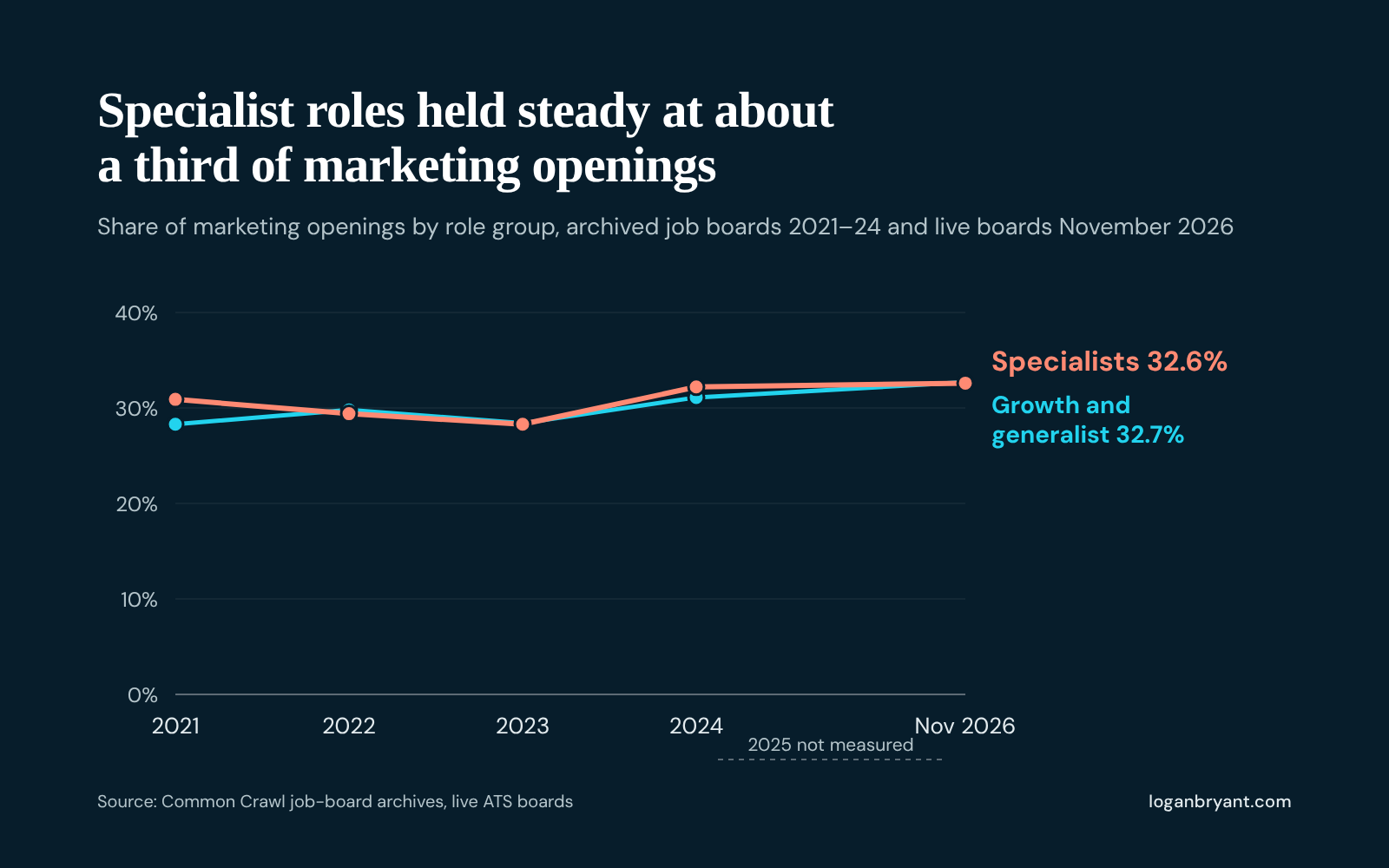
Source: Common Crawl archives of Greenhouse, Lever and Ashby job boards (mid-year 2021 to 2024) and live boards (Nov 2, 2026); 14,857 marketing openings.
Applying each role type's share to that smaller pool gives a rough estimate of how many openings each one lost.
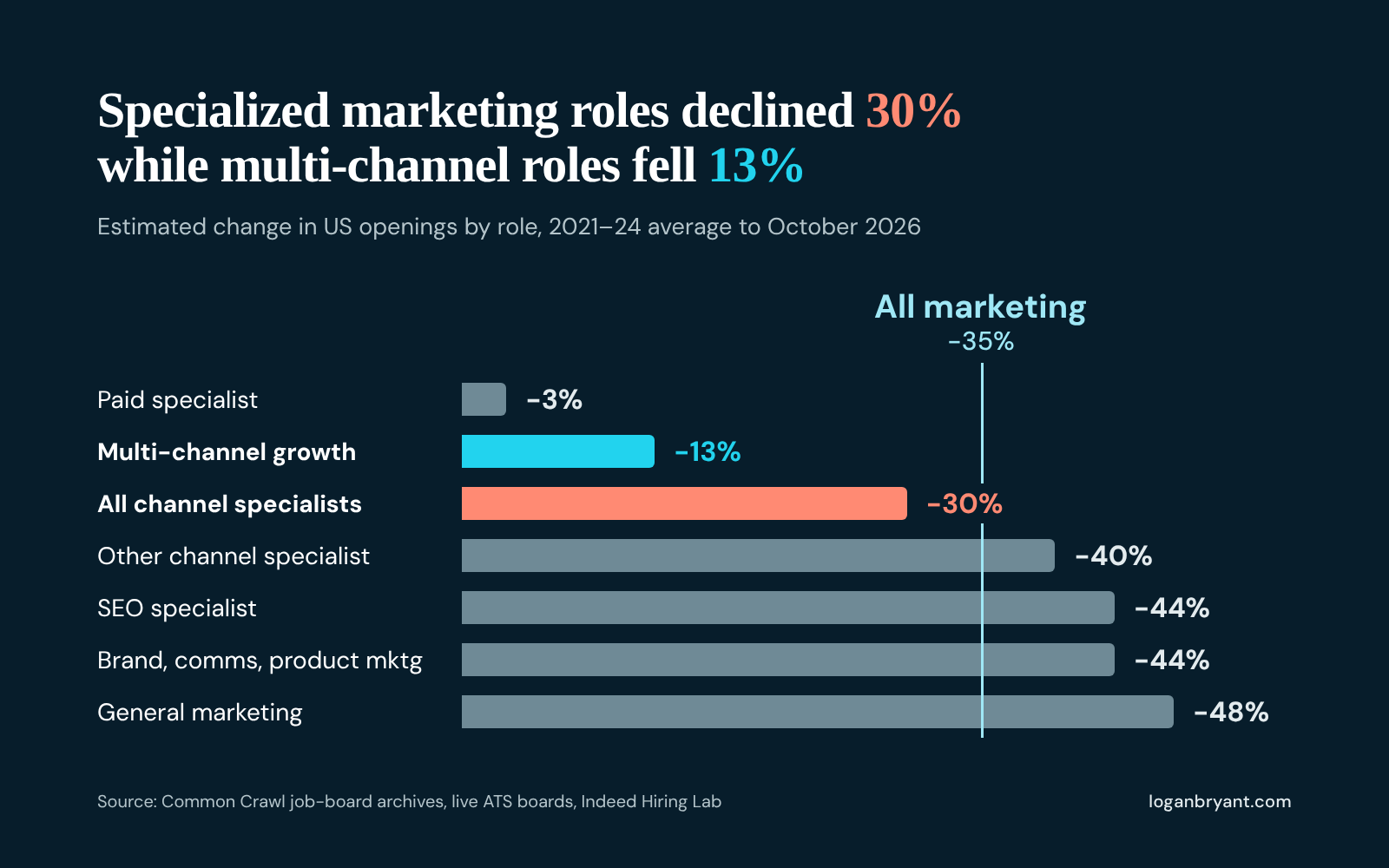
Estimate: each role type's share of openings in this study multiplied by Indeed Hiring Lab's US marketing postings index (2021 to 2024 average vs Oct 2026).
The specialist cohort hides a pretty important split in terms of which roles made up the difference. Paid media held almost steady at about 3% down, while SEO lost about 44% and lifecycle, CRO, content and social roles lost about 40%. General marketing roles (titles like Marketing Manager with no channel attached) fell the most at about 48%, so multi-channel marketers significantly held ground against the marketing generalists.
When I tracked the same companies from mid-2022 to today, I found the same trend: marketing openings fell by about half, SEO openings by about 70%, and growth openings by only about a quarter.
Hypothesis 2: Are fewer companies opening specialist positions?
How I tested it. I took the 578 companies that had a job board both in mid-2022 and today, and checked whether each one was posting each role type at both points in time. This allowed me to see which companies stopped hiring for a role vs which ones started. Since fewer of these companies hire marketers at all now (345 in 2022, 250 today), I also compared the share of marketing-hiring companies posting each role to account for the general slowdown..
What I found. SEO took the biggest hit. For every company that started posting SEO roles, about three stopped. Growth roles had the best ratio of any role type, with 60 companies starting for every 86 that stopped.
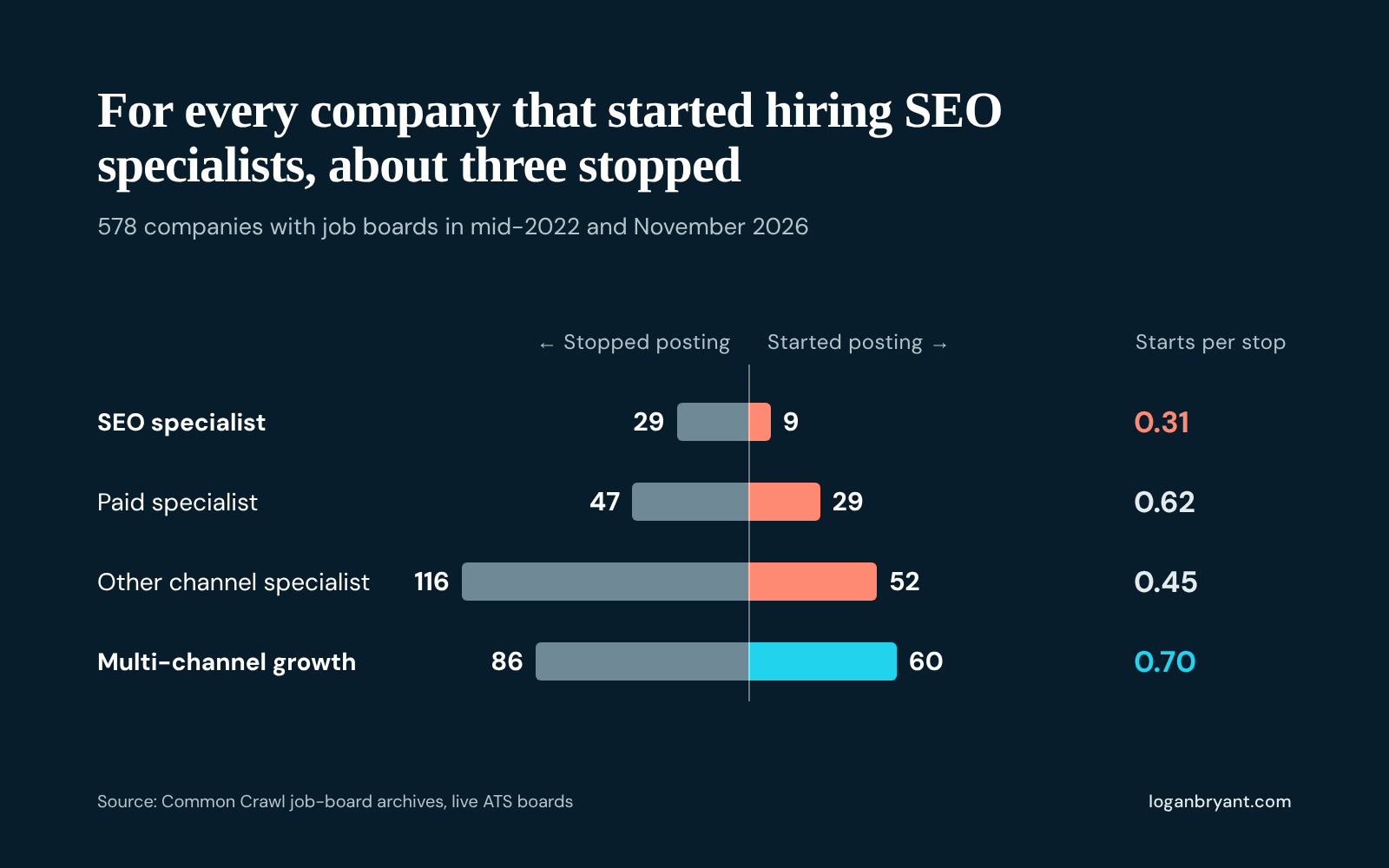
Source: Common Crawl archive (mid-2022) vs live Greenhouse, Lever and Ashby boards (Nov 2, 2026); 578 companies with boards in both.
| Role type | Share of marketing-hiring companies, 2022 | Today | Change |
|---|---|---|---|
SEO specialist | 9.9% | 5.6% | Down, borderline (p = 0.07) |
Other channel specialist | 42.3% | 32.8% | Down (p = 0.02) |
Any specialist | 51.3% | 44.8% | Down, not significant |
Paid specialist | 17.7% | 17.2% | Flat |
Multi-channel growth | 37.1% | 40.8% | Up, not significant |
On the 2022 panel, the drop for specialists as a whole is too small to call. Measured from 2021, the peak hiring year, it's much clearer. Among the 450 companies with boards in both mid-2021 and today, the share of marketing-hiring companies posting any specialist role fell from 60% to 39% (p < 0.001), while the change for growth roles was too small to call. Next to the first hypothesis, that means specialist jobs still make up about a third of marketing openings, but fewer companies post them.
One caveat for this part, since each company is checked on a single day per period. A company with a specialist role that happened to be filled on that day counts as having stopped. That discrepancy is more pronounced for roles a company hires one at a time, like SEO, so the SEO drop is probably somewhat overstated compared with larger role types like growth.
Hypothesis 3: Are generalists absorbing the specialists’ work?
How I tested it. I tracked how much of the marketing market multi-channel growth roles take up, then read the 2,285 marketing job descriptions currently posted by the 2,313 tech companies in the live sample (most had no marketing openings) and flagged which channels each one asks the role to handle. I used SEO as the test channel because its vocabulary is distinct and easiest for me to spot with my own background.
What I found. Multi-channel growth roles took a bigger share of marketing openings. They rose from 16.7% of marketing openings in 2021 to 2024 to 22.4% today (p < 0.0001), and among the same companies tracked since 2022 they went from 15.2% to 23.3%.
Multi-channel growth roles now outnumber SEO specialists about 8 to 1, which is up from a ratio of 4.8 to 1.
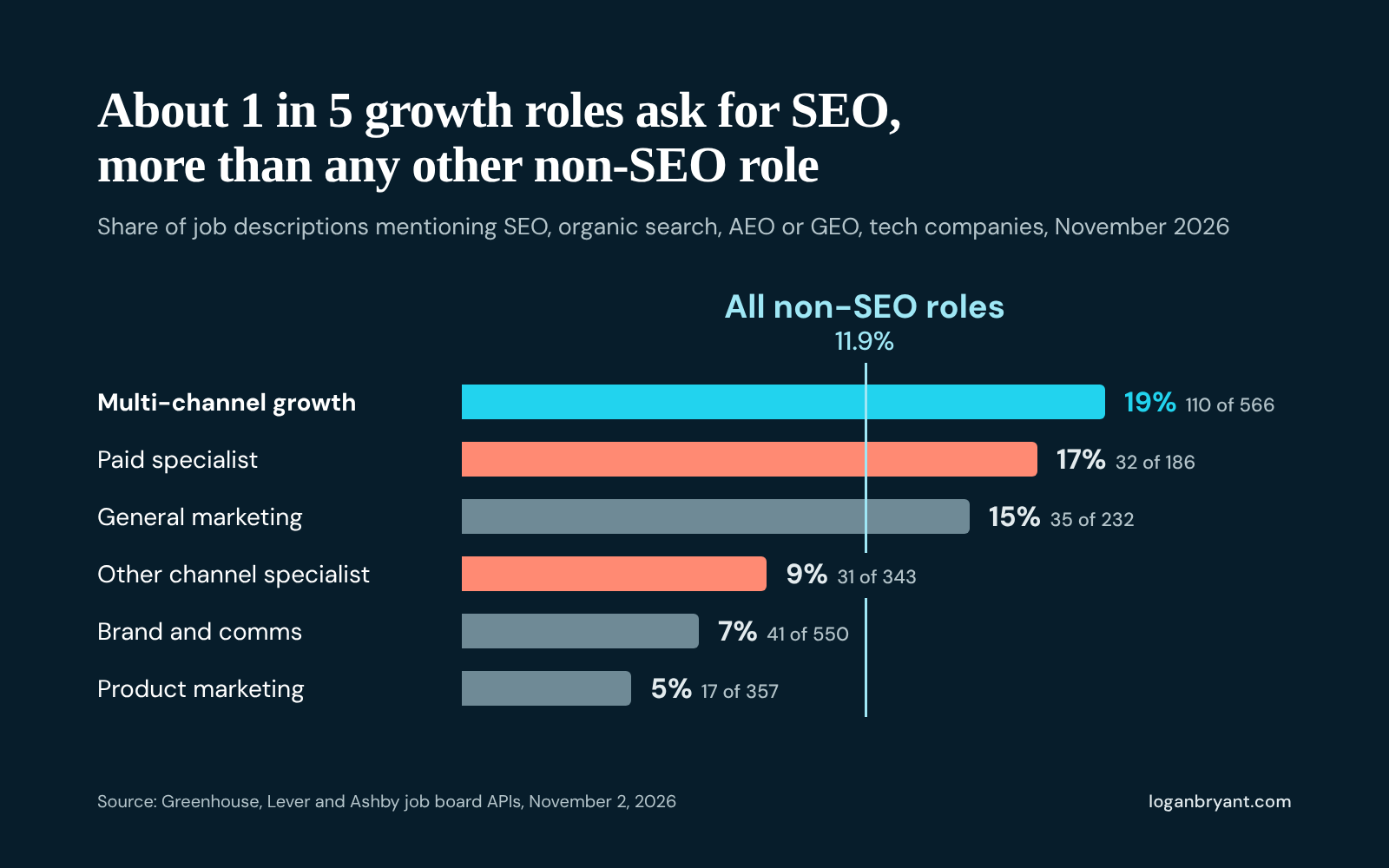
Source: Greenhouse, Lever and Ashby job board APIs, Nov 2, 2026; 2,234 non-SEO marketing roles at 2,313 tech companies.
There is some silver lining in this though.
At tech companies, about 1 in 5 growth job descriptions mention SEO, which is more than any other non-specialist role and well above the 12% average.
Nearly half (48%) of roles spanning three or more channels include organic search, and so do about a third of Head, VP and Director of Growth roles. At the 51 largest tech employers in the sample (200 or more open jobs each), only 2 of 352 marketing openings were SEO roles, while growth roles made up 30%.
The main difference comes from the number of growth roles, since the share of each one that mentions SEO actually fell, from 24% in archived 2021 to 2025 postings to 18% today across all companies. Growth roles now outnumber SEO roles about 8 to 1, so growth postings mentioning SEO outnumber SEO specialist postings by roughly 4 to 3.
Hypothesis 4: Are junior specialist roles disappearing?
How I tested it. I looked at SEO & AEO titles, since the job titles have clear indications for seniority (Junior, Specialist, Sr. Specialist, Manager, Sr. Manager, etc.).
What I found. Junior and mid-level roles shrank. From 2021 to 2024, they were a steady 45% to 48% of SEO openings, but today they’ve fallen to just 34% (p = 0.02).
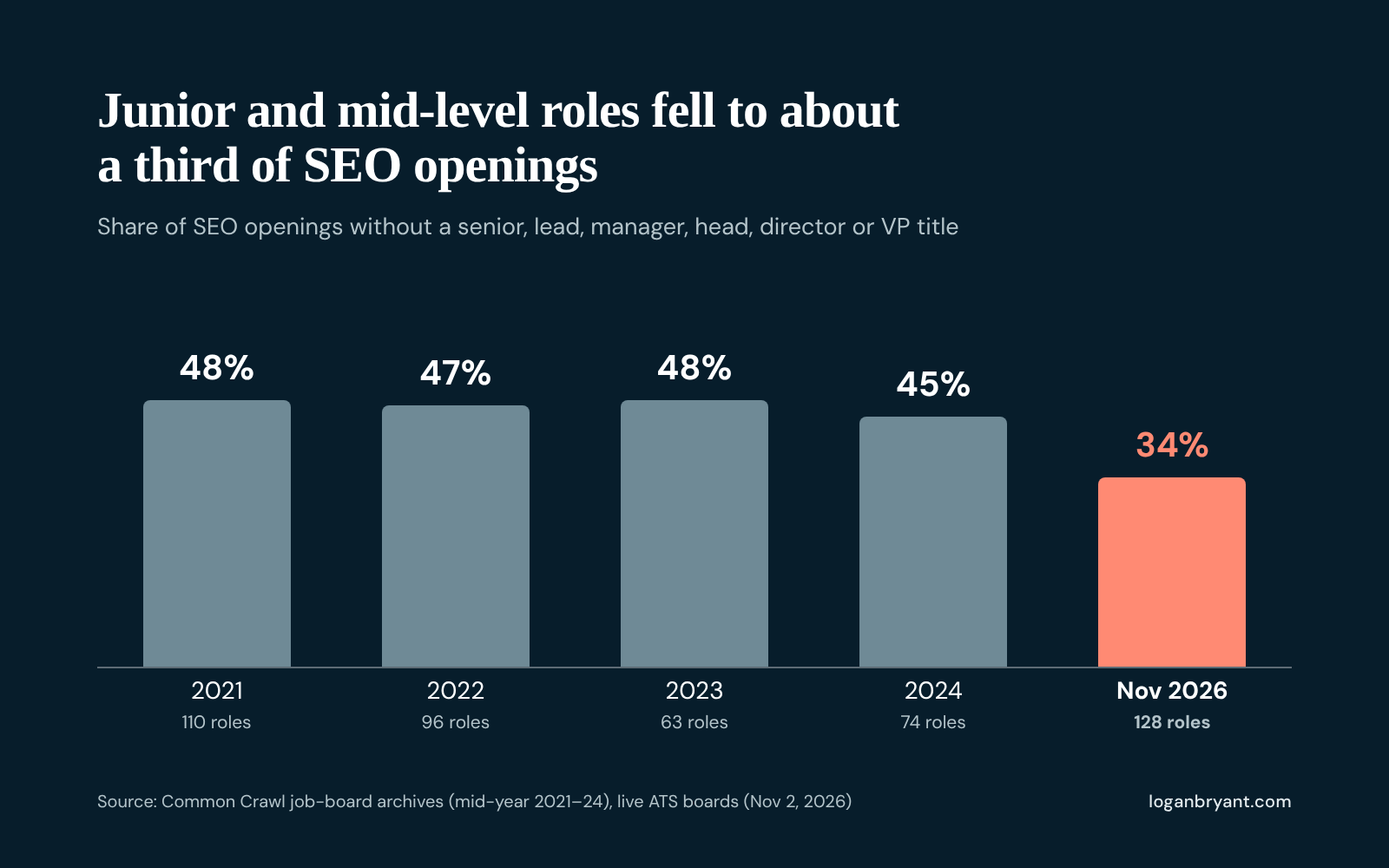
Source: Common Crawl archives of Greenhouse, Lever and Ashby job boards (mid-year 2021 to 2024) and live boards (Nov 2, 2026).
Further research showed the same pattern. Senior titles make up 59% of current SEO listings on Indeed, according to Semrush, and according to the Content Marketing Institute, one in three companies have been reducing entry-level marketing hiring.
In content marketing, Semrush found that postings for content marketing managers and specialists fell by about three quarters while head and VP of content roles grew.
Hypothesis 5: Are specialist roles being cut?
How I tested it. Job postings can't show me if a role was cut from the roster or filled by a candidate, so I needed to look at people instead of job openings.
I took every company in the job-board data that posted an SEO role in 2021 to 2023 and has none open today, plus a comparison group of companies that are posting SEO roles right now. For each one, I counted current employees on LinkedIn whose headline names an SEO, AEO or GEO role, and got usable pages for 53 companies that stopped hiring and 14 that are still hiring. I also pulled US quit and layoff rates from the Bureau of Labor Statistics to see whether people overall are staying in their jobs longer.
What I found. This is the one hypothesis I couldn't validate. At 39 of the 53 companies that stopped posting SEO roles (74%), at least one person with an SEO title still works there. I believe this looks more like teams that stopped hiring than teams that slashed the role. Another problem here is that today’s headcount doesn’t show whether a team of six shrank to two or was two all along. Admittedly, my research process here is too limited to draw a conclusion.
| Stopped posting SEO roles | Still posting SEO roles | |
|---|---|---|
Companies checked | 53 | 14 |
Have at least 1 SEO-titled employee | 74% | 50% |
Have 3 or more | 38% | 29% |
Median SEO-titled employees | 2 | 0.5 |
The comparison group was interesting nonetheless. Companies that stopped hiring SEO specialists are more likely to have them on staff than companies still hiring them, and half of the companies posting SEO roles today don't seem to have an SEO person yet.
Broader national trends have been indicating that people are quitting less and staying longer in their positions, which appears to be aligned with my limited findings. According to the Bureau of Labor Statistics, monthly quit rates fell from 2.8% in June 2022 to 1.9% in August 2026, while layoffs stayed flat at about 1% a month the whole time.
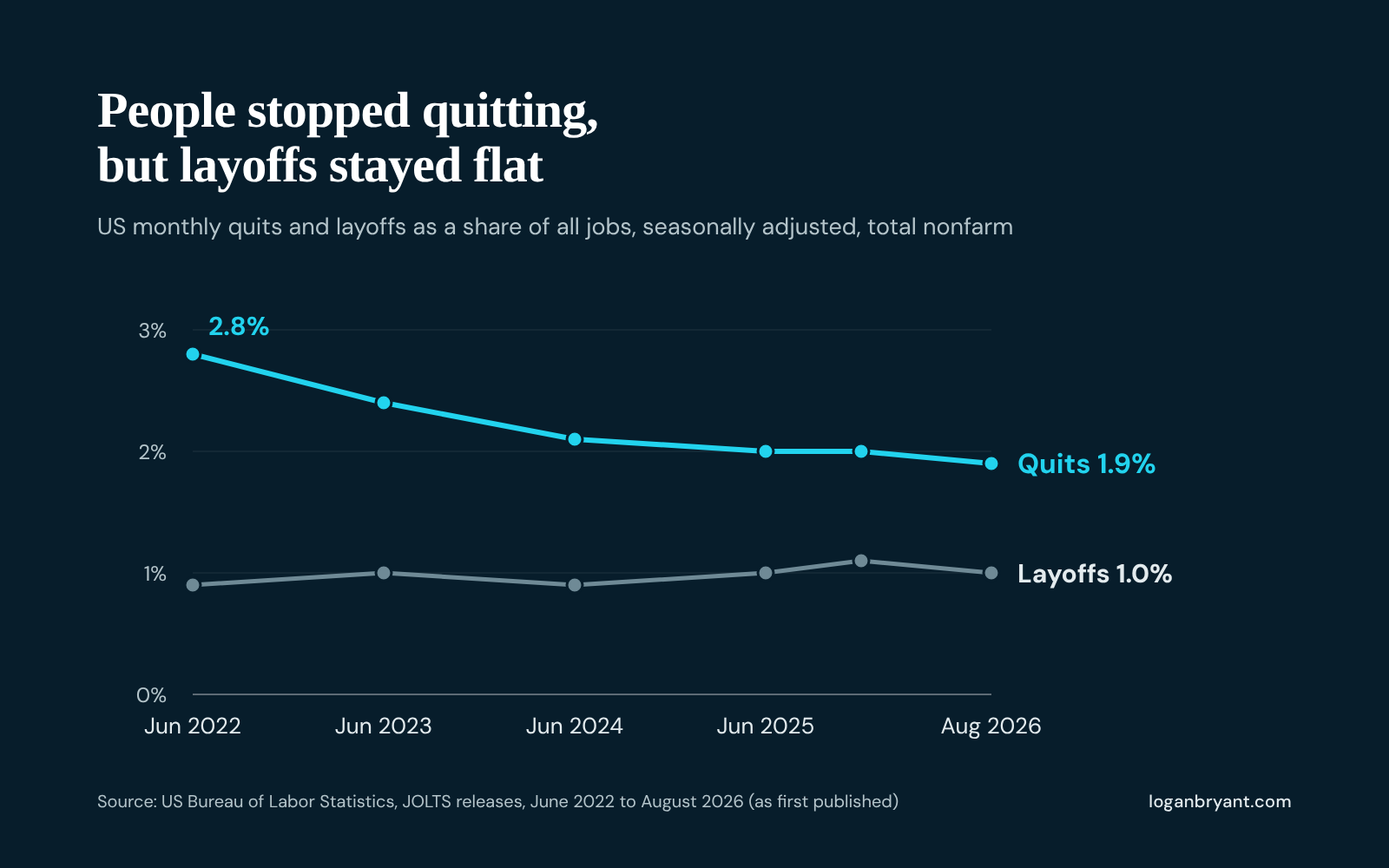
Source: US Bureau of Labor Statistics, Job Openings and Labor Turnover Survey releases, Jun 2022 to Aug 2026 (as first published).
Additionally, median tenure in the private sector rose from 3.5 years in 2024 to 3.9 years in 2026, and the government's count of market research analysts and marketing specialists (the category that includes SEO) grew from about 728,000 jobs in 2021 to about 900,000 in 2025.
But the reduction in marketing jobs is still concerning. A 2026 study of 110 million employment records across 164,780 firms found marketing headcount fell slightly relative to other functions after ChatGPT launched, and marketers laid off recently took 5.2 months on average to find work in the Content Marketing Institute's early-2026 survey, up from 3.1 months in 2024.
What I think is happening. Most specialist teams seem to have frozen rather than disappeared, with people staying longer in their seats, which is why fewer doors are opening for candidates.
Once again, this is my unvalidated hypothesis, so we can’t be sure about it. In my limited research, 14 of the 53 companies (26%) show no one with an SEO title today, and we don’t know why. These could mean anything from a role being cut, absorbed by another contributor, a title change, or people who left and weren't replaced.
But for anyone on the hunt for a specialist job, the data still shows us that fewer open positions are being made available on the market.
So, are marketing specialists in trouble?
The data indicates that some are indeed trending down.
Specialist jobs kept their slice of a shrinking pool, which still means roughly 30% fewer openings, and in fewer companies.
Specialist hiring appears to be concentrated in fewer companies, and the specialist teams that remain tend to post fewer new roles. Meanwhile, growth roles have held up better than any marketing role except paid media, losing about 13% of openings, and about 1 in 5 of them include organic search.
Paid media is the one specialty that held its ground. My guess is that's because paid results are the easiest to tie to revenue, but the data can't confirm this theory.
What this means for you
If you're a specialist, the jobs still exist, but there are fewer of them and these doors are opening less often.
The specialist roles that are opening favor senior marketers (about two thirds of SEO openings today).
Now may be a more important time than ever to follow Rand Fishkin’s advice and expand your channel expertise toward becoming a T-shaped marketer.
If you're a generalist or growth marketer, you're in the type of marketing role that has held up best in the AI era. Now, growth roles now make up a bigger slice of a smaller market, which could mean more of the specialist work will become your responsibility. About 1 in 5 growth job descriptions ask for SEO, and nearly half of multi-channel roles include organic search.
For hiring managers, I would caution you to remember that a growth marketer covering five channels won't have the depth a specialist brings to any single one of them. No single individual will be capable of bringing true channel expertise, which means that you’ll need to prioritize the skills and expertise you’re looking for in a T-shaped marketer, rather than seeking out unicorns.
Plus, the rising demand for multi-channel growth marketers will make your dream candidate even more difficult to secure as the people with years of experience are in higher demand for more open roles. This may be the time to bet on moving your specialists upward, rather than searching for your unicorn.
Methodology and limitations
Data sources.
| Source | What it measures | Coverage |
|---|---|---|
Archived job boards (Common Crawl) | Marketing openings by role type | 15,425 Greenhouse, Lever and Ashby boards from mid-year crawls, 2021 to 2024; 10,377 unique marketing openings |
Live job boards (Greenhouse, Lever and Ashby public APIs) | Marketing openings and full job descriptions | 5,146 live boards on Nov 2, 2026; 4,480 unique marketing openings |
Same-company panel | Which companies stopped or started posting each role | 578 companies with boards in mid-2022 and Nov 2026 |
LinkedIn company pages | Current employees with SEO titles | 67 companies, viewed Nov 2 to 3, 2026 |
US Bureau of Labor Statistics | Quits, layoffs, tenure and occupational employment | National data, 2021 to 2026 |
Indeed Hiring Lab | US marketing job postings index | Daily, 2020 to Oct 2026 |
Classification. Job titles were sorted into seven role types with keyword rules, and engineering, sales and product management titles were excluded even when they mention marketing words. A company counts as tech when at least 20% of its open roles are engineering, product or data roles. Job descriptions were scanned for eight channels (SEO and AI search, paid search, paid social, CRO, email and lifecycle, content, affiliate and partnerships, organic social), and a role mentioning three or more counts as multi-channel.
Statistics. Differences between periods were tested with Fisher's exact test, and year-over-year trends with a Cochran-Armitage trend test. I call a result supported when p is below 0.05, and say so plainly when it isn't. The estimated changes in openings apply this study's role shares to Indeed's US marketing postings index, so they're approximate.
Limitations.
- Three hiring systems only. Greenhouse, Lever and Ashby lean toward startups and mid-size tech companies, so enterprises on Workday or their own careers sites are under-represented.
- Two collection methods. The 2021 to 2024 figures come from archived board pages and the 2026 figures from live APIs. The marketing share of all openings is similar under both (3.4% to 4.2% in 2021 to 2024, 3.6% today), which suggests they're comparable.
- Archived 2025 and 2026 boards were excluded. Greenhouse's newer board format loads jobs in pages, so those captures undercount openings.
- Postings are not hires. Reposted roles and openings that are never filled inflate counts.
- Mentions are not ownership. A channel named in a job description might be a nice-to-have rather than a core duty.
- The LinkedIn check is a snapshot. It covers 67 companies, relies on headlines that name an SEO role, and can't show how big those teams were in 2022.
Sources
- Common Crawl, crawls CC-MAIN-2021-25, 2022-27, 2023-23 and 2024-26
- Greenhouse job board API, Lever postings API and Ashby job board API
- Indeed Hiring Lab job postings data
- BLS Job Openings and Labor Turnover Survey, August 2026, with earlier releases for June 2022, June 2023, June 2024, June 2025 and December 2025
- BLS Employee Tenure, September 2026
- BLS Occupational Employment and Wage Statistics: Market Research Analysts and Marketing Specialists (2024 and 2025 figures from secondary sources citing BLS data)
- Zhu, Knight, Colicev and Bart, marketing employment after generative AI (SSRN, 2026)
- Content Marketing Institute career and salary outlook
- Semrush SEO job market study
- Semrush content marketing jobs analysis, via Digital Information World
- LinkedIn company People pages for 67 companies (53 that stopped posting SEO roles and 14 still posting them), viewed November 2 to 3, 2026