

In September of 2024, FinTech startup Airbase announced a major acquisition deal with Paylocity, one of the largest HR and payroll software companies in Tech.
During the nine months leading up to that announcement, I worked with the Airbase team to grow the company’s SEO program and build out an early AEO motion around the bottom-of-funnel questions their buyers were already asking.
With the help of Airbase’s amazing marketing team, we reached the following milestones before the acquisition:
- Doubled, or 2X, the number of unique monthly users from Organic Non-Brand
- Increased monthly MQLs from Organic Non-Brand by 40%
- Published 56 human-written, original articles with briefs and strategy for bottom-of-funnel targets
- Gained 187+ Google AI Overviews for high-intent, non-branded finance software searches
- Tripled Airbase’s visibility in AI answers for bottom-of-funnel spend management, AP automation, and competitor-comparison questions
- Doubled AI-assisted MQLs from visitors with an identifiable AI referral source
- Implemented a systematized process to scale and synchronize the SEO and AEO content generation program
- Boosted SEO performance and MQLs through additional projects and activities such as CRO and SEO testing
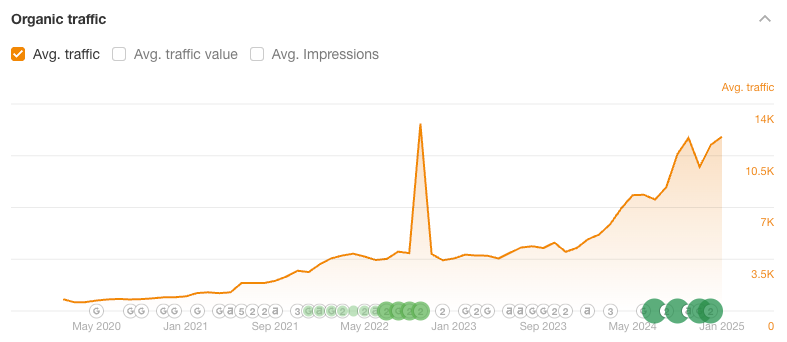
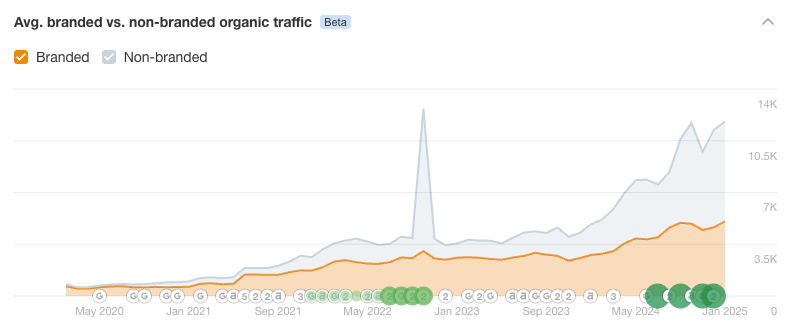
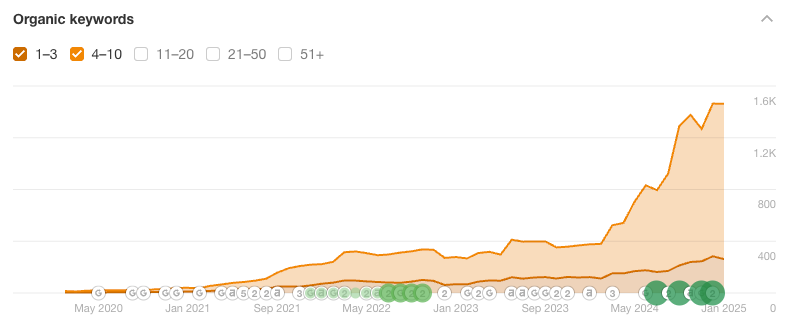
Using Ahrefs as an accessible source for third-party SEO data, I’ve included the following screenshots:
Overall Traffic Growth
Non-Branded Traffic Growth vs. Branded Growth
Organic Keyword Growth: Positions 1–3 and 4–10
How Our Success Was Generated… Getting to “Yes”
Winning the deal to work with Airbase required some convincing.
At the time that my colleague, John Martinez, and I opened the discussions, Airbase was under contract with a full-service SEO agency. We needed to build a case for the department head to give our services a shot while they continued to fulfill their contract with the agency.
Having showcased my Tipalti case study, Airbase was eager to work with us. The department head advocated for budget to allow us to get started while they finished out their contract.
Redirecting Resources to Bottom-of-Funnel
Easily the biggest change we helped Airbase make during the shift from old agency to new services was redirecting their content creation efforts from top-of-funnel to bottom-of-funnel, or BOFU strategy.
Not only did this strategic shift help re-orient the team’s resources in a meaningful direction, it also won the trust of Airbase’s Director of Content, who had some justifiable reservations from her past experiences with SEO programs. Specifically, the types of articles proposed in the past were not aligned with or interesting to Airbase’s core audience of highly educated finance professionals. Yikes!
As I helped her understand more about the type of content I was proposing, and showcased the BOFU content strategy, we shook off those old reservations. The Director of Content quickly became excited about the direction we were about to pursue.
AEO-Specific Work: Turning BOFU Content Into AI Answer Visibility
As the BOFU content program started gaining traction, we began mapping keywords and query fan-outs to Airbase’s buyer decision matrices to build a reliable prompt library and track visibility through OtterlyAI.
Specific AI prompts touched each stage of Airbase’s buyer journey across spend management, AP automation, competitor comparisons, and whether specific finance software could solve the problems they were dealing with.
I didn’t treat AEO as a separate content strategy with its own disconnected list of topics. We used the same BOFU lens that was already working for SEO and we expanded it to understand how Airbase was appearing in AI answers and where we had opportunities to improve visibility.
To keep the work measurable, we built a library of 112 prompts across ChatGPT, Google AI Overviews, Perplexity, and Microsoft Copilot.
We used a baseline measurement system so we could see where Airbase was appearing, where it was being left out, and which types of questions were creating the biggest visibility gaps, which helped us avoid confusing AI noise for signal.
We kept Airbase’s standard JavaScript and HTML experience in place for human visitors. But the biggest AEO technical enhancement was adding edge-level routing to deliver clear markdown representations for AI agents. We did this to ensure the delivery and readability without making agents crawl and render heavy code.
Lastly, we used the visibility data alongside our SEO research, buyer decision matrices, and content priorities to identify where Airbase needed better coverage.
When we found a gap, we could decide whether it called for a new piece of content, a stronger comparison page, a product-page improvement, or a technical enhancement. Then we added that work back into the same priority log and execution process that was already driving the SEO program.
By the end of the engagement, Airbase had gained 187+ Google AI Overviews for high-intent, non-branded finance software searches. We had also tripled visibility in AI answers for BOFU spend management, AP automation, and competitor-comparison questions, while doubling AI-assisted MQLs from identifiable AI referral sources.
The program we created became a 100% connected and repeatable process tying SEO, AEO, content, technical work, and buyer journeys together. Still, at the end of the engagement BOFU content was, and remains the star of the show.
Process Implementation & Education
What I love most about working with startups like Airbase is their willingness to adopt the processes that I’ve developed for scaling SEO programs. Of course, these processes require education and communication to execute effectively, so I began building the following processes and integrating and educating Airbase’s team on how to use them.
- The SEO Priority Log, which became the backbone of the program and my spin on what some would call a “content calendar”
- The SEO Testing Dashboard
- The Keyword TAM
- My content brief templates and processes
- Various ad-hoc processes used to address opportunity analysis and prioritization of efforts
Early Success & Execution
Although traffic growth didn’t take off immediately, it didn’t take long for our first articles to begin generating MQLs for Airbase.
The VP of Demand Gen, who had been stressing the need to grow quickly, saw these MQLs come through. They became the perfect indicators of early success that we needed to maintain focus on retaining and growing the program.
By this time, we had already built the plan.
Now we just needed to work the plan.
Each week, we reviewed our projects and opportunities with ruthless prioritization so that our efforts wouldn’t be wasted on non-impactful activities.
I provided all of the upfront research, analysis, and brief generation to hand off to the Director of Content. The work then went into Airbase’s publication queue. We simply rinsed and repeated this until it became clockwork.
Concurrently, the SEO testing program and other optimization activities had already been kicking in, along with our Featured Snippet wins and optimizations.
Over a period of nine months, we created the results listed above.
Acquisition and Future Changes
At the time of this writing, I am not privy to, nor at liberty to say, what changes will come to the Airbase.com domain during and after the acquisition process with Paylocity.
I am, however, extremely pleased with the work we did and the results we generated to date.
Big thanks to the entire Airbase Demand Gen team for working with me and believing in the program every step of the way. I can’t wait to see more exciting growth as Airbase becomes a driving force for Paylocity.
Ask Me Anything
Got a strategy question? I answer every email.